
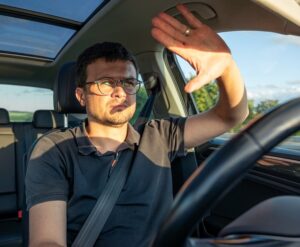
 During autumn and winter, low sun can become a serious hazard when driving. We have covered this subject before but it’s such an important safety issue it’s worth revisiting. UK Government statistics indicate that low sun contributes to 3,000 car accidents a year of which over 400 will result in serious injury and 35 will be fatalities.
We’re at the time of the year when the sun sits lower in the sky and very low sun typically coincides with the morning and evening commute to work. You can easily be dazzled and temporarily blinded by the dazzling glare from a low sun.
How polarised sunglasses can help when driving in low sun
Wearing polarised sunglasses when driving in low sun will help. Polarised sunglasses are designed to help block the glare that is reflected off flat surfaces, such as roads. They will improve visual comfort in bright conditions and reduce the dazzling glare from low sun. View our range of polarised sunglasses.
5 tips for safer driving in low sun conditions
Here are some sensible actions you can take to mitigate against the hazards of low sun when driving:
- Keep your windscreen clean inside and out.
- Increase the distance between you and the vehicle in front of you.
- If blinded, slow down immediately. It is tempting to carry on regardless to let the glare pass but by then it may be too late.
- Wear polarised sunglasses – they are designed to cut glare and are recommended by the AA, The RAC and Road Safety GB.
- If you normally wear prescription spectacles for driving keep a pair of prescription sunglasses in the car.