
Following the last news post about polarised lenses, along a similar theme we thought it worthwhile explaining what the different sunglass lens categories mean. The category number equates to a percentage of the VLT (Visible Light Transmission) that is, how much light the lens lets through. The higher the VLT the lighter the lens, conversely the lower the VLT the darker the tint will be, blocking more light coming through to the eye, as follows: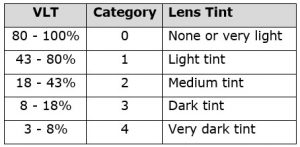
- Category 0: 80-100% VLT
- Category 1: 43-80% VLT
- Category 2: 18-43% VLT
- Category 3: 8-18% VLT
- Category 4: 3-8% VLT
The following is a general guide to the categories that apply to different lens colours. This has to be a general guide as the VLT can cover quite a wide a spectrum such as Category 1 which is 43-80%. Some lens colours are right on the “border” e.g. a yellow lens can have 78% VLT which is on the border between Category 0 and Category 1.
- Category 0 – Clear, Light Yellow, Pale Orange
- Category 1 – Yellow, Orange, Rose & Vermilion
- Category 2 – Purple, Red, Amber & Light brown
- Category 3 – ‘Standard’ Grey & Brown
- Category 4 – Dark Grey & Dark Brown
Virtually all the grey and brown lens sunglasses we sell are Category 3 and suitable for use in strong sun conditions. See our range of leisure sunglasses.
Category 4 sunglasses are a specialist lens for intense sunlight/high glare conditions and they are clearly denoted in the product description. They also appeal to people that have very light-sensitive eyes (called photophobia). It’s important to note that a category 4 lens must not be used for driving as they are too dark and therefore potentially dangerous. It’s also worth pointing out that tint has nothing to do with blocking UVR. You can buy cheap sunglasses with a category 3 lens but without UV filters it can let in very harmful levels of UVR, damaging the eye. This is why good quality sunglasses have UV coatings applied to the lenses. Some lens materials do naturally block UV such as glass and polycarbonate.
 One of the questions we’re often asked is “what makes a polarised lens different?” Light waves from the sun travel in all directions but when they strike a surface like a road or water they begin vibrating in one direction, usually horizontally. This is called polarised light and it’s this harsh concentrated light – glare – that make it difficult to see and uncomfortable for your eyes. Polarised lenses are different to standard sunglass lenses; they have a special filter film either sandwiched between two other layers of the lens or applied to the front of a lens. The polarising filters used in polarised sunglasses absorb the horizontally-vibrating waves that reflect off a surface. That means that only vertically-vibrating waves get through the filter and reach your eye. This greatly reduces the intensity of reflective glare. Non-polarised sunglass lenses only reduce the amount of light entering the eye; they don’t block glare.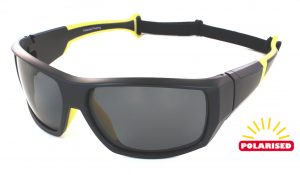



 ou’re now regularly wearing a mask on your face you’ll have noticed that your sunglasses, spectacles or medical goggles are prone to misting up. This is because the mask directs your breath upwards instead of in front of you, which is good for preventing disease transmission but a nuisance as it interferes with your vision. Sports eyewear that’s close fitting is also prone to mist up and for that reason we have Evolution branded anti-fog products. The one shown is made for us by an Italian company and it’s the most effective anti-fog product we’ve tested (and we’ve tested many!). You’ll find it in our
  In the recently released May edition of Sporting Shooter magazine, editor Rebecca Green said, ‘Evolution Eyewear has long been the go-to brand for shooting glasses’. This was the lead comment on an editorial piece on our new
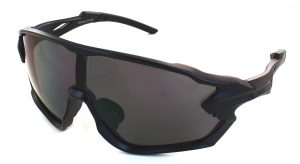
  Evolution has one of the largest ranges of interchangeable multi-lens sets of any manufacturer and another new addition is Crossfire 3. A great looking cross-over sport and leisure style sunglass that’s true unisex. It has a matte black frame and lenses made from impact resistant, shatterproof polycarbonate. The frame also features non-slip, adjustable nosepads. Lenses are class 1 optical grade and UV400 rated. It’s supplied with 3 interchangeable lenses: grey, orange and yellow. Lens changing is quick and easy. Great value, Crossfire 3 is just £34.95 supplied with a soft pouch, cleaning cloth and hard case – and free UK delivery!
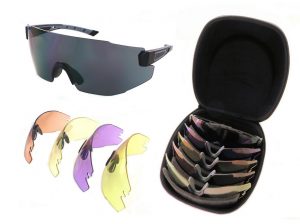 We’re delighted to announce the launch of Evolution Edge, the latest addition to UK’s best-selling shooting eyewear. Manufactured exclusively for us and 12 months in development, this technically advanced shooting eyewear suits all clay target disciplines and will also appeal to field sports enthusiasts.
 The new
  Primarily aimed at shooting enthusiasts,